Are you ready for some geyser photos? Like a whole bunch? I hope so, 'cause this post is full of them!
 |
| Norris Geyser Basin |
Continuing from where I left off in my
last post, after spending the morning at Yellowstone NP's Mud Volcano and then the Grand Canyon of the Yellowstone, my friend Kim and I headed to Canyon Village to find lunch. After refueling and buying some souvenirs from the nearby shops, we were back in the car and off to see more of the park.
 |
| Porcelain Basin overlook |
From long-ago trips to Yellowstone, I remembered really enjoying the Norris Geyser Basin. Since we were nearby, that became the next stop on our day's agenda.
 |
| All kinds of hot springs and geysers to see |
The hottest, oldest, and most dynamic of Yellowstone's geothermal areas, Norris Geyser Basin is a must-see for anyone visiting the park. Home to 193 named geysers (4th highest number of geysers of the geothermal areas in Yellowstone) this unique area sits on the intersection of two fault lines. In 1959 Norris Geyser Basin experienced an earthquake measuring 7.4 on the Richter scale. Unlike other geyser basins in the park, the majority of the waters at Norris are acidic rather than alkaline, including some very rare acid geysers.
 |
| An extensive boardwalk system kept tourists safe |
Although this area is extremely popular, Kim and I snagged a parking spot in the main lot. As a matter of fact, parking spots were plentiful on this Sunday mid-afternoon in early June. I gulped at the parking lot signs warning of potential vehicle paint and glass damage when the Steamboat Geyser erupts. But I decided to roll the dice (I later learned that this geyser erupts infrequently - more on that later in this post.)
 |
| Ledge Geyser |
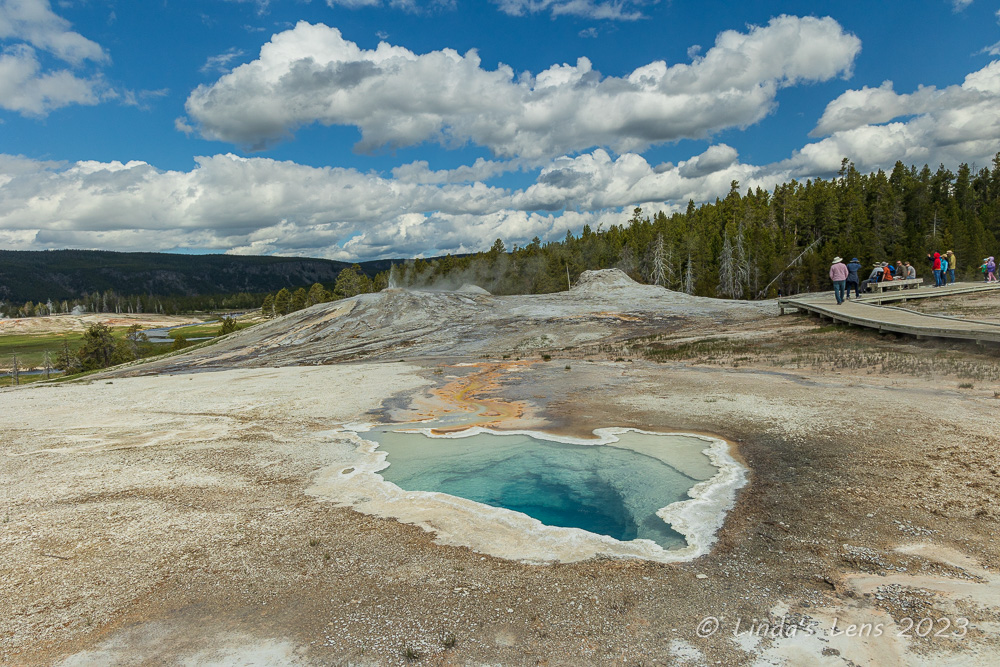
Norris Geyser Basin has two distinct areas - Porcelain Basin and Back Basin. The former is a large barren area with lots of colorful springs, while the latter is heavily wooded. Where to start first? Although Back Basin was the longer loop, our first glimpse was an overview of the wide-open Porcelain Basin. The area looked so intriguing, Kim and I found ourselves pulled towards its boardwalks.
 |
| Interesting colors coming out of this geyser |
Walking down a steep hill, we passed steaming Ledge Geyser. Past this little puffer, we came upon the first of many boardwalks providing tourists safe passage over these hot, acidic geothermal areas.
 |
| The boardwalk crossed this colorful stream |
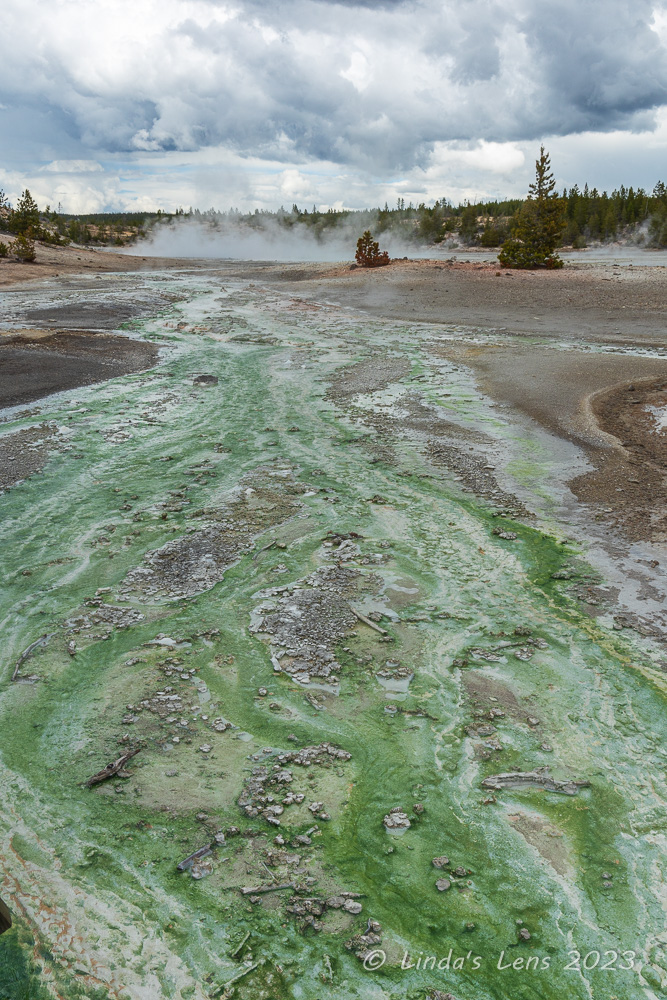
Our boardwalk of choice led Kim and I into a large barren area. The soil was predominantly a whitish color, due to a mineral named siliceous sinter (also called geyserite), derived from the thermal activity. There were small pools of water everywhere, and one large stream ran through, and under, the boardwalk itself. This channel was an unusual green hue. Although the water temperature here was above the boiling point, a lime-green algae called Cyanidium thrived in these hot, acidic waters, creating this otherworldly color. Other microscopic organisms and bacteria also produced unique water hues.
 |
| Unique green hue due to Cyanidium algae |
Kim and I continued along the looped boardwalk trail, past round eerie blue pools, more steam-spouting geysers, and bubbling water features.
 |
| Dead trees poisoned by the acidic springs |
The entire area was devoid of trees, the surrounding forest killed off by the high water temperatures and acidic geysers.
 |
| Another great overview of Porcelain Basin |
On a clear day, one can get a nice view of the nearby snow-capped mountains. But today the skies were cloudy. As a matter of fact, Kim and I noticed a bank of dark clouds beginning to drift in.
 |
| I'm having too much fun taking pictures! |
No matter, we were here to see all the geysers! Kim and I continued on, hoping the rain would hold off until we were finished with our sightseeing.
 |
| Three blue pools |
After completing the Porcelain Basin boardwalk loop, we noticed another elevated boardwalk heading away from Ledge Geyser. It led to a stark, white hill known as Porcelain Springs.
 |
| Looking towards Porcelain Springs |
An interesting sight, this white mound had several geysers rising from its plain, as evidenced by numerous steam plumes.
 |
| Porcelain Springs |
Surely not something you see every day!
 |
| The water from this lake is creeping into the forest |
On our way back from Porcelain Springs, I passed by this little pond that was slowly overtaking a grove of trees. The water was a murky blue-green, probably boiling hot and full of minerals and acids. I assumed those poor trees weren't long for this world.
 |
| A very colorful sight |
Another overview of Porcelain Basin. More interesting colors - a bit of research determined the rusty orange color was due to an algae called cyanobacteria.
 |
| The standard warning sign |
Because the threat of boiling hot water and acid isn't enough to deter some people, the National Park Service had several warning signs posted on the boardwalk railings. Despite this, every year I hear stories of some dumb tourist who wanders onto the fragile surface of these geothermal areas. Sadly, there's always someone who ends up falling into a geyser and getting cooked.
 |
| Emerald Spring |
Our trip through Porcelain Basin left Kim and I thirsty and in need of a restroom (despite the cloud cover it was a warm day!) Since the only bathroom was all the way back at the parking lot, we took a break and I ran back to my car for some water bottles.
 |
| Steamboat Geyser |
Our needs taken care of for the moment, it was now time to explore the other part of Norris Geyser Basin - the area known as Back Basin. A bit longer of a loop - 1.5 miles - Kim and I hoped we could cover the distance before we got rained on.
The first geyser we came to on this trail was the famous Steamboat Geyser. Having the distinction of being the world's tallest active geyser, it throws water up to 300 feet in the air during a major eruption. So much water is expelled, it rushes back into the geyser vents carrying mud, sand and rock which are again shot skyward. The recirculating water ends up coating everything with a layer of silica. Now I understood the reason for the parking lot warning signs!
 |
| People waiting for Steamboat Geyser to erupt |
However, this geyser also erupts very infrequently. Although it's been known to go 50 years between blasts, the Steamboat geyser began an eruptive period in 2018. Since then eruptions have been much more frequent, ranging between 5 and 77 day intervals. Although the day we visited geyser was emitting steam clouds, it didn't look like an eruption was imminent. At the lower viewing platform, Kim and I noticed a group of people seated in chairs. Another tourist told us these people were waiting for the Steamboat Geyser to erupt. Apparently these people spend entire days sitting here just watching. Much more dedicated than I'll ever be!
(On a side note, the date of this visit was June 2nd and about a week later I read that the Steamboat geyser had a major eruption on June 9th. I hope some of these people we saw waiting got to see it!)
 |
| Looking down on Cistern Spring |
Located downhill from the Steamboat Geyser was a small blue pool named Cistern Spring. I later read that this hot spring has a connection with it's large geyser neighbor. When Steamboat's eruptions are less frequent, Cistern Spring's water temperature and discharge increase. But this little spring drains after Steamboat Geyser's major eruptions.
 |
| Colorful Echinus Geyser |
Further down the boardwalk was an especially colorful pool of water named Echinus Geyser. Echinus has the distinction of being the world's largest acid-water geyser. The waters here are nearly as acidic as vinegar, with a PH ranging from 3.3 to 3.6. In past years, eruptions were frequent, but for the last several years they have become extremely rare.
 |
| Another look at Echinus Geyser |
Downstream of the main pool, colorful water rivulets channeled through the soil. It was a lovely sight. Echinus became one of my favorite geysers in Back Basin.
 |
| Crater Spring |
Along the boardwalk Kim and I wandered, me snapping images of every geyser we came across. Luckily most of the geysers had small logs with name plaques in front so months later, when putting this blog post together, I could remember which photo was which!
 |
| Surprise! Wildflowers growing amidst the geysers |
In this desolate, acid-killed environment I was surprised to see a patch of pink wildflowers growing next to the boardwalk. This tough little plant was apparently resistant to all the heat and acidity.
 |
| Kim was having a great time |
Despite threatening skies, so far nothing wet had yet fallen from the sky. But the clouds overhead were looking mighty dark. Kim and I pressed on, quickly trying to cover the remainder of the basin before the weather changed.
 |
| Mystic Spring |
I really loved all the different colors of the various springs and geysers. Apparently colorless or yellow water indicates the hottest temperatures, while oranges, browns and greens have cooler waters (but probably still boiling!)
 |
| Beautiful blue hot spring |
This one was so blue and clear! Sadly this was one of the few pools that I neglected to take a photo of the sign. (Looking on the map of Back Basin there is one feature called "Dishwater Spring." Maybe it's that one?)
 |
| My favorite name for a Geyser |
This little geyser called "Puff 'n Stuff" wins my vote for the best name of all! It was certainly my favorite.
 |
| Animals obviously don't mind the hot water |
Although for safety reasons, people aren't allowed to step off the boardwalks, the local animals seem to wander through without issue. I spotted several bison and elk tracks in the mud and a huge poo pile next to one of the hot springs. Since there weren't any dead bodies around, I guess the animals know enough to stay away from the hot water.
 |
| Three small hot pools |
Kim and I rounded the last corner - only a few more geysers to see! Would we make it before the rain?
 |
| Veteran Geyser |
A colorful hump of orange sulfur deposits framed the Veteran Geyser's vent.
 |
| The sulfur mound was interesting |
It's pond was a sickly orange-ish color. Although the sulfur formations were interesting, the icky outflow wasn't.
 |
| I think this one was Monarch Geyser |
We passed the colorful Monarch Geyser and then hustled by the steaming, bubbling Minute Geyser, which was very active that day.
 |
| Bubbling Minute Geyser |
Kim and I had done it! We'd visited all the geysers in the Back Basin. Now to return to our car in the parking lot - about a half mile walk away. We'd just started up hill from our last geyser when our luck finally ran out. The skies opened up into a massive downpour. The day being so warm, we'd both left our rain jackets in the car. Luckily I had my camera bag to protect my camera, but without any jackets Kim and I got totally soaked.
 |
| Rainstorm aftermath |
When we finally made it to the car, Kim took a funny pic of our soaked selves. We looked like a couple of drowned rats!
 |
| Old Faithful Inn |
Now the hour was approaching 5 o'clock, and it was time to make our way to our lodging for the evening. We'd splurged and reserved a room at the Old Faithful Inn. From Norris it was 30 miles away, but on the park roads it took nearly an hour to get there. It didn't help that we encountered road construction between Madison Junction and the Old Faithful area. Although our inbound route wasn't too bad, the opposite direction heading out of the park was backed up for several miles.
 |
| The Inn had a huge stone fireplace |
I love National Park lodges and the Old Faithful Inn had all the features one would expect and more. A tall stone fireplace and chimney dominated the building's center. Decorative log railings encircled all three levels. Comfortable wooden chairs were placed everywhere.
 |
The decor was "National Park rustic"
|
After unloading our stuff I took my car to search for a parking space in the large, but crowded parking lot. After driving to nearly the end, I finally spotted an open spot. A man and young boy happened to be standing in the slot I was trying to claim. Seeing my approach, they reluctantly moved over but stayed beside the adjacent vehicle. I thought "Boy that's really rude." Upon exiting my car, I looked up and saw a huge buffalo standing right in front of the car beside mine. The man and his kid had been in my parking space, using the adjacent vehicle as a shield from the huge beast.
 |
| Lots of seating! |
After settling our things in our room, Kim and I hustled out to the nearby cafeteria to get some dinner before they closed. (The place closed the ridiculously early hour of 7 o'clock!) We paid a small fortune for a truly terrible hamburger and fries.
 |
| Crowd waiting for Old Faithful to erupt |
Of course one of the perks to staying at the Old Faithful Inn was that it was a stone's throw away from Yellowstone National Park's most famous geyser - Old Faithful itself. One of the most regular and predictable geysers in the park, since 2000 Old Faithful has erupted every 44 minutes to 2 hours. After dinner, we consulted the visitor center for the next predicted eruption time.
 |
| Thar she blows! |
About 20 minutes prior to the estimated eruption time, Kim and I wandered out to the edge of this most famous geyser. Encircled by a wide boardwalk with seating in some areas, the place was already filling up with tourists. We stood off to one side and waited.....and waited. The predicted eruption time came and went. And yet we still waited..... The geyser shot up a small stream of water that got our hopes up, but then it stopped. Kim and I joked that Old Faithful wasn't living up to its name.
 |
| This geyser puts on a show |
But finally, nearly 25 minutes past it's predicted time, water began bubbling to the surface again. Was this another false alarm? After a few initial spurts, a long column of water rose into the sky. It was finally happening!
If you've ever watched a geyser erupt, it's a awe-inspiring sight. It's amazing to think there's enough pressure under the earth to force a column of water to rise over one hundred feet into the air. The eruption went on for a good two minutes. Kim videoed the entire thing on her phone, while I attempted to photograph the geyser in action. Not only was I at a bad angle to catch the water plume, it was near sunset and the light was terrible. But I edited a few photos to include here so my readers could see it.
 |
| Beautiful clouds in the sky |
After the show was over, Kim and I finished the evening enjoying a beer in Old Faithful Inn's lounge. We sat next to a couple from New York and it was interesting chatting with them about their travels in the area. So far that day we'd met people from all over. Yellowstone NP is known world-wide and attracts quite a diverse crowd.
But finally the beer and the long day took it's toll, and we retired to our nice, but expensive, room for the evening. Tomorrow Kim and I would spend another day touring the park, including all the geysers in the Old Faithful area. To be continued in my next post....