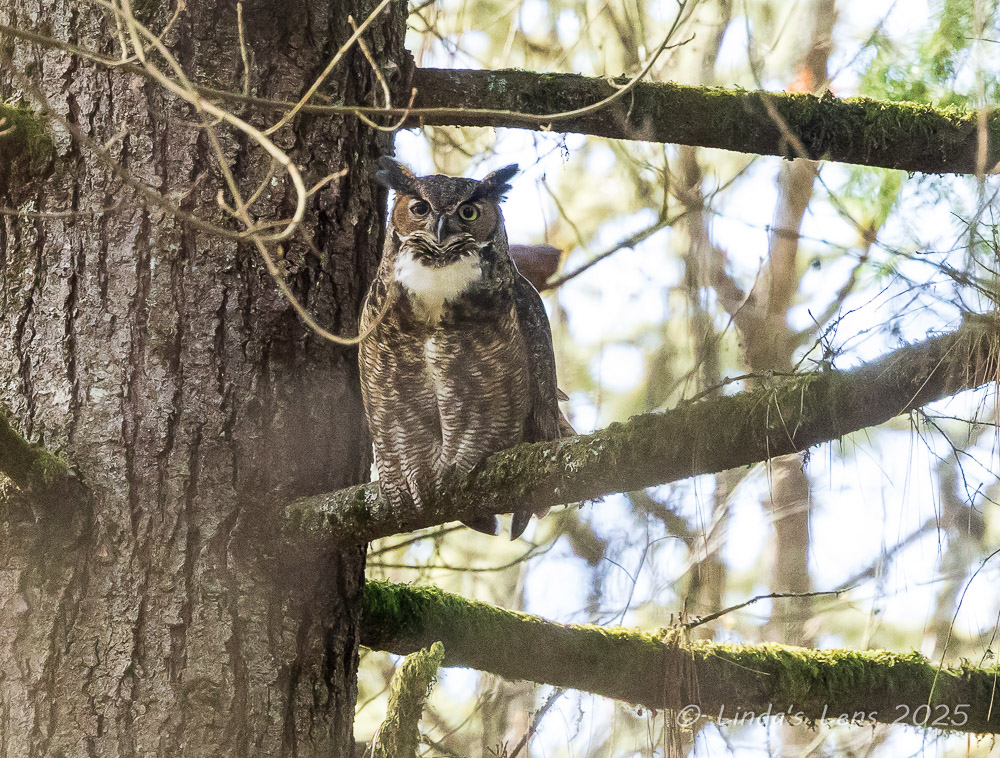
Showing posts with label birds. Show all posts

Friday, February 20, 2026

The Wood Duck Pond

During the winter months, when not skiing or hiking, I'm often found with my camera perusing the local parks and nature areas in search of interesting birds to photograph.  Although some of my feathered friends migrate, quite a few species stick around all year.


A gorgeously colored male wood duck

One of my favorite birds to photograph is the wood duck.  The males sport stunning multicolored plumage and eerie, bright red eyes.  Although wood ducks are not super common in my area, a few flocks of them are known to inhabit certain local ponds.  One, adjacent to a nearby business park, provides the most reliable source of wood duck sightings.


Looking at his reflection

One sunny January afternoon, having a few hours free, I decided to head over to the wood duck pond to see if I could spot any of these colorful waterfowl.  The pond is located in the middle of a linear greenway between several large office buildings and a local library branch.  It's a serene place to take a walk, with wide pathways linking the many small water features scattered throughout.  After taking in the huge flocks of Canada geese that always seem to overwhelm the basin next to the library, I continued along the walkway for a short distance until arriving at the wood duck pond.


More wood duck reflections

Luck was with me that day!  I immediately spotted several wood duck couples along the pond's forested shoreline.  Of course seeing me approach toting a large white lens, they all turned tail and swam in the opposite direction.


Female wood duck fishing for dinner

However, after many years of wildlife photography now under my belt, I knew if I just stood still and waited, the ducks would return.  Which is what they eventually did.  


A ducky couple

And then it was game on!  Positioning myself on a pedestrian bridge spanning one end of the pond provided a great vantage point.  One male duck in particular kept swimming into a sunny area of the pond quite close to where I stood.  The bright sunlight illuminated his iridescent feathers wonderfully as well as providing some nice reflections in the water below him.


Female wood duck in beautiful light

Although not quite as spectacularly colored, the female wood ducks are also beautiful.  Although mostly brown, their back feathers have a small bit of blue-green iridescent hues nestled in between the regular browns.  (Why is it always the male birds that get the attractive colors?)


This wood duck had some sort of food

The wood ducks get their name from their habit of nesting in tree cavities close to water.  Although some are migratory, 75% of the wood ducks in the Pacific flyway stay close to home.  In the wood duck pond that I visited on this day, the ducks here live year-round.


Ring-necked duck

After a successful photography session, I left the wood duck pond with hundreds of images on my camera's memory card.  Passing by a few more water features on the way back to my car, I captured a beautiful ring-necked duck, water droplets beading on his oily feathers, and an inquisitive golden-crowned sparrow. 


Golden crowned sparrow giving me the eye


Hope you've enjoyed these "birdy" photos from my neck of the woods!  


Saturday, January 24, 2026

Hangin' With the Owls

Cheri, my friend, neighbor, and photography mentor is a fabulous wildlife photographer.  One of her favorite subjects is owls.  She's a pro at catching these magnificent birds in flight, and always knows where to find them.  


A short eared owl looking my way

During the winter months, short eared owls migrate to the Pacific Northwest and frequent wide open grassy fields to hunt.  Cheri had been visiting a nearby natural area where the "shorties" (as she and her photography buddies have adorably nicknamed them) could be seen in abundance.  She posted some amazing images of these beautiful owls in flight.  I started having owl envy.  So I asked Cheri if I could tag along on her next outing.


Sitting atop a fence post

I'd visited this particular natural area many times before and didn't have a good track record when it came to spotting owls.  In the past, every time I accompanied Cheri here the owls either didn't appear or were so far away it made photography challenging.  I joked to Cheri that my presence was bad luck for seeing short eared owls.  But Cheri was determined to find some owls that I could photograph and encouraged me not to give up.


Time to go!

So one afternoon in early January Cheri and I traveled to the local natural area where the short eared owls hung out.  Since the "shorties" (and most other owl species) began hunting near dusk, we wanted to be in place well before sunset.


Another liftoff - look at those legs!

Bird sighting news travels fast among the local wildlife photographer community and when we arrived there were at least a couple dozen other people scattered about the field, large lenses in tow.


A flyby

At first there was no owl action to be seen.  But after about an hour of waiting, someone spotted the first shortie fly-by.  Soon after three different owls could be seen soaring above the grassy fields.


"Enough with the pictures!"

The owls weren't flying close to where Cheri and I were at.  Some of the photographers started to walk closer towards the field where the owls were hunting.  Although it was tempting to follow them, Cheri encouraged me to stay put.  After many days of visiting this location, she knew that the shorties would eventually fly closer to where we stood.  Besides, it seemed about the time one walked over to where the owls were, the little buggers would fly off somewhere else - usually the place you'd originally been waiting!


Looking for dinner

Cheri, of course, was right.  Eventually the little owls began soaring over the fields closer to where she and I were stationed.  Then two of the birds started to circle a marshy area behind us.  One of the owls kept landing on a nearby fence post.  A couple of people waded through the water to get a closer vantage.


In flight

I couldn't stand it any longer and followed the other photographers through the swampy field to be closer to the owl's flight patterns.  It turned out to be an excellent decision.  Two short eared owls kept flying around the field directly adjacent to the fence.  One particular owl kept landing on the same post.


Flying near the water

Having not captured moving birds for awhile, my photography skills were quite rusty.  At first my ratio of in-focus shots to blurry misses was quite dismal.  But with a bit of practice eventually I was able to get a few keepers.


Some close flight pics

The bright sunlight made photography a bit challenging, especially when the owls flew directly into the sun.  Since I shoot in manual mode, I was forever making exposure adjustments.  (Note to self - start experimenting with aperture and shutter priority modes.)


One of my faves

After a good half hour of watching the two shorties soar back and forth across the field, one owl flew straight at myself and the two other photographers who were beside me.  It soared right over our heads!  I was awed by the quiet, smooth flight of this beautiful bird.  The close owl encounter was quite amazing - a definite highlight of the day.

Wings spread out

With dark fast approaching, I waded back across the marshy field to meet up with Cheri.  From her spot she'd also had great views of the short eared owls soaring across the field.  She even captured images of an owl and harrier fighting in flight.  It had been a most successful afternoon!


Crusin'

Short eared owls are medium sized birds, usually about the size of a crow or mallard duck.  They get their name from small tufts of feathers on their heads, resembling ears.  These tufts are small enough they are often not visible.  Short eared owls have large heads, short necks, broad wings, and adorable black-rimmed yellow eyes.  They fly low over fields using floppy wingbeats, often looking like giant moths.  Shorties live in open grassland areas throughout the world and feed mainly on rodents.


A cute chipping sparrow

I'm happy to report that my short eared owl curse has now been lifted.  I came away from that photo session with many images of these gorgeous birds in flight.  Hope you've enjoyed my photo gallery!


Monday, December 8, 2025

A Very Busy Mother Grebe

One day in mid-August I got a call from my neighbor, friend, and photographic mentor Cheri.  She's a fantastic wildlife photographer and has taught me everything I know about bird photography.  Cheri always has a pulse on where interesting birds can be found.  She told me a mother Western grebe with babies had been spotted at a local lake.  This water bird is unusual because the mother carries her babies on her back as she swims around.  Cheri was planning to visit the lake in hopes of finding the mama grebe and invited me to join her.  This sounded like such an adorable sight, of course I jumped at the chance to come along.


Western Grebes carry their babies on their backs

The following morning Cheri and I rose early and picked up a third member of our party, Cheri's good friend (and also amazing photographer) Dotty.  We three ladies headed down the freeway, bound for our destination - the Western grebe lake.


"Hello"

After driving for about two hours, Cheri pulled into the large lake and recreation area.  The person that had tipped Cheri off about the mother grebe had told her it was "near the marina."  But which one?  This lake had several.  Not knowing which direction to go, Cheri randomly followed the first "marina" sign she came upon.  Parking in the nearby lot, we peered over toward a large area with several docks where boats of every shape and size were tied up.  Was this the right marina?

Luck was with us that day.  Getting out of the car to investigate, we walked towards a spot of open water between the boat dock and shore.  Cheri spotted the mother grebe right away.  


Snuggle time

No one expected we'd find her so quickly!  All three of us ladies hightailed it back to Cheri's car to grab our cameras.  Then we lined up along the shore and snapped away.


A mother's love

The Western grebe is a striking bird, with a long, slender, swan-like neck, bright yellow bill, and vivid red eyes.  About the size of a small goose, Western grebes have black bodies accented with a white neck and chest.  They are diving birds, living in bodies of water and feeding on small fish and amphibians.  Their most endearing trait is that the mother will carry her newly-hatched babies around on her back.  Western grebes also perform an elaborate courtship ritual, called rushing, where a mating pair will run across the water in unison, wings lifted and heads curved forward.


Mom's two copilots

The mother Western grebe was casually floating around near the moored boats.  Two downy, gray babies were sleeping between her back feathers.  Such a precious sight just a short distance in front of us!  And the early morning light was fantastic.  My friends and I moved to a nearby dock to get better light and a closer angle.


Dad brings a fish for junior

The little grebe babies definitely didn't look like newborns.  They were quite large and appeared nearly ready to strike out on their own.  But they were still small enough to fit on their mama's back - for now.  


"More food dad!"

After watching mama grebe float around the dock area, the babies woke up and began to shuffle about.  Their tiny faces were absolutely adorable, as were their antics.  The siblings pecked at each other and flapped their little wings.  Then we noticed the babies started to get even more animated.  To our surprise, the father Western grebe popped up from under the water right in front of the mother with a small fish in his beak.  The little ones had heard dad coming.  It was feeding time!


Cruising around the lake

Oh my gosh, if the grebe with babies on her back wasn't cute enough, now my friends and I were going to witness the youngsters being fed!  Both babies strained their necks towards daddy, vying for breakfast.  The stronger one reached him first and was able to grab the fish, which was quickly wolfed down.


Dad brings another catch

My friends and I were fortunate enough to watch several iterations of the baby grebes being fed.  The father would swim away towards the open waters of the lake, and return a short time later with another fish.  One time he brought back a very large fish.  One of the babies grabbed it in his beak and tried in vain to swallow it, but this fish was too big for it's throat.  I was afraid we'd witness the cute little fluffball choking to death, however at the last minute mama grebe took the fish away from junior and ate it herself.


Which baby will get the fish?

All mothers need a break from their young, so after several feeding sessions, the mother grebe dumped both her babies into the water.  Old enough to swim, the little guys headed over to their father, who allowed them to board his back.  It was dad's turn to babysit.  Mama swam off to enjoy a little bit of free time.  However, she didn't go far.  Daddy grebe decided to give his kids a tour of the larger lake and started heading towards open water.  He was just about past the docks when mama grebe zipped up to him, squawking loudly.  The kids promptly jumped off their father's back and onto hers.  It appeared mama grebe was scolding her husband for taking the kids out of the safe area.  My friends and I guessed the dock area provided more protection for the baby grebes, and the mother was doing what all moms do to protect her offspring.


Down the hatch!

Cheri, Dotty and I spent a solid two hours sitting on the dock watching our new favorite Western grebe family.  After awhile, the feedings stopped and papa grebe swam away towards the lake's center.  The babies snuggled into their mother's feathers and she tucked her head protectively around them.  Then all three grebes drifted off to sleep.  Such a sweet sight, it was the perfect ending to a wonderful morning.


Dinner time

My friends and I came away from our morning photo session with thousands of excellent images.  Back home, sorting and choosing the very best ones proved to be a monumental task.  But I also found it be surprisingly enjoyable - looking through the morning's precious captures made me smile.  I learned all about a "new to me" species of bird and have the pictures to prove it.

Huge thanks to Cheri for allowing me to tag along!


Wednesday, May 7, 2025

An "Owl" Kinda Day

I monitor the bird activity at many of the local parks and natural areas on the "ebird" app.  It's a great resource to clue me in on what birds have been spotted around town.  I'm always eager to capture some of the more unusual birds with my camera lens.  Late last March someone posted a photograph of a nest containing two great horned owlets spotted the nearby nature park.  I knew I had to find them.


Barred owl sleeping in a tree

My buddy Kim is always up for a walk in the park, so she and I teamed up for an owl hunt.  From the ebird image one could tell the owl nest was sited atop an unusually curved tree trunk.  Kim and I were frequent visitors of the nature park's trails and knew the place pretty well.  That tree shouldn't be too hard to identify, we reasoned.  Little did we know.......


Who-o's there?

Kim and I started on one end of the park, and began combing its trails.  Not far down our first path we came upon a lady with a long lens pointing upwards.  She informed us there was a barred owl sleeping on a branch above our heads.  Although not the species of owl we were seeking, any kind of owl sighting is marvelous, so I followed the direction of her lens and soon spotted a lovely brown and white owl snoozing in a nearby tree.


I found the Great Horned owlets!


I spent at least 20 minutes watching and photographing the barrel owl.  In time, our voices woke the bird and he gave us a few surly glances, annoyed we'd disturbed his nap.  This was our cue to move on.  We had baby owls to find!


These guys look like muppets

Kim and I ended up walking a large circle, exploring nearly every trail in the nature park, with still no sign of the little owls.  We were next to the very last trail, ready to give up, when a man passed by, and noticing my big lens, asked us if we'd seen the owl nest yet.  When I replied that we'd been searching for it all afternoon, the man told us where to find it.  And of course the nest was on the only trail we'd yet to cover.


Mama owl in a nearby tree


After hustling down this last trail, a crowd of people looking into the forest clued us in that we'd finally found the spot.  And there in the thicket of trees and bushes high in the crook of a large fir tree was the nest.  Lucky for us, the two baby owlets were awake and peering out at the onlookers.


Only one owlet when I returned a few days later

The gray, fluffy babies were cute!  They kind of looked like muppets, with fierce stares.  There was no sign of either parent the entire time.  After a half-hour photography session, the day was getting late and the light had begun to fade, so Kim and I reluctantly left.


Mother owl giving me the stink-eye

Jazzed by this very exciting baby owl encounter, I couldn't stay away and returned just a couple of days later.  This time, the mother owl was perched in a nearby tree, asleep on a branch, and only one of the owlets was in the nest.  Another photographer who happened to be there at the same time as I said she heard one of the owlets had already fledged.  Wow, so soon!  The owlets didn't look old enough to fly yet.


First trillium of spring!


But just two days later I learned via another local photographer that both owlets had indeed left the nest.  I felt lucky to have been able to photograph both babies when they not quite ready to fledge.  It's not everyday one sees an owl in the forest, and spotting a nest with young ones is even rarer.  


Spotted Towhee striking a pose

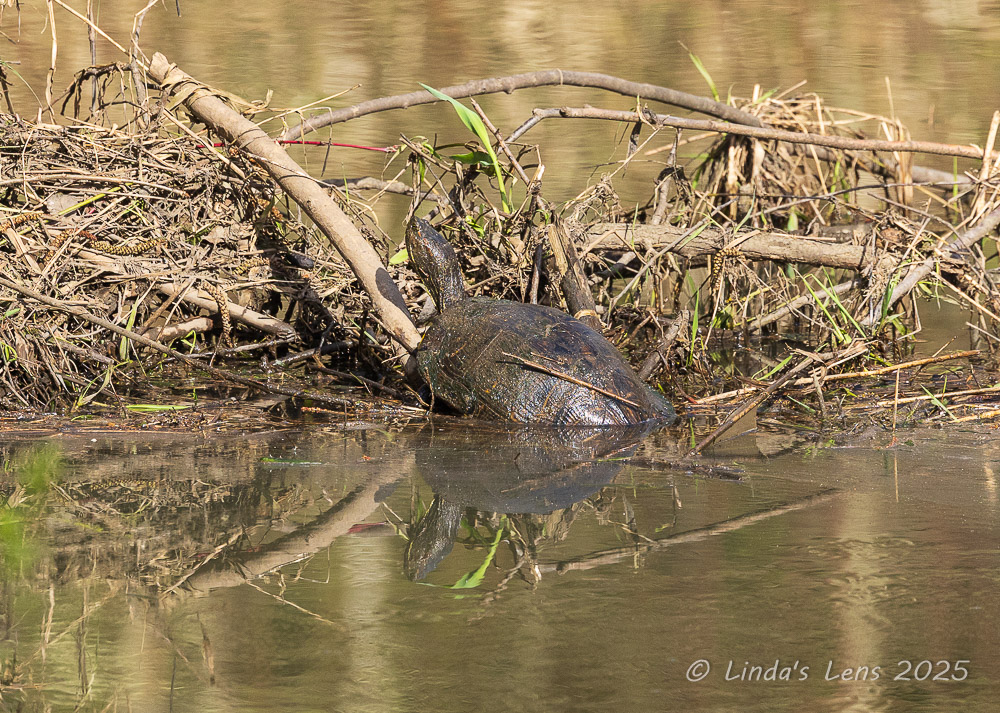
I'd close this post with a couple photos of other spring finds in the nature park.  Like the season's first trillium bloom and a beautiful Spotted Towhee striking the perfect pose for my camera.  And a shy pond turtle peeking his head up from the water's surface.


Pond turtle

Spring is such a wonderful time of year!  The flowers are blooming, trees are bursting with vibrant green leaves, and the birds are singing happy songs.  And if you're lucky you might just spot a few nests with youngsters in them.  


Thursday, March 13, 2025

More Drama at the Duck Pond

Are you all ready for part two?

I often take walks around a local suburban park hoping to see aquatic birds fishing for dinner.  In case you missed my last post, I shared photos captured at this neighborhood duck pond of two cormorants fighting over a fish one of them had just caught.  


This little Pied-billed grebe caught a large carp


A couple weeks after my first photo encounter, I was back again scanning the pond surface for diving waterfowl.  I spied a Pied-billed grebe near one end and began to watch the little guy repeatedly dive and surface.  I hoped he'd eventually come up with a fish.


Trying to swallow the fish....but it was too big


After about 5 minutes, my patience paid off.  The grebe surfaced with a good sized carp in his beak.  He swirled it around in the water, and then tried to swallow his catch.  But it appeared the fish was too big for the little grebe's throat.  The grebe hoisted the fish into his beak again and again, but to no avail.


Then two cormorants tried to take the fish away


Now for the drama.....two cormorants suddenly appeared out of nowhere and began to harass the grebe.  They wanted his fish.


Lots of mayhem ensued!

But the little grebe wasn't giving up without a fight.  He swung his fish-laden beak around and around, and swam as fast as he could hoping to evade the thieves.


The grebe tried in vain to evade his attackers


When he wasn't dodging his attackers, the grebe tried desperately to swallow his fish, hoping to get it down before it got taken away.


Then the grebe tried desperately to swallow his catch

Sadly, the fish was too big for the grebe's mouth, and try as he might, it wasn't going down.


Another frantic swallowing attempt

After about about 5 minutes of commotion, one cormorant was able to swoop in and grab the grebe's fish, and immediately gulp it down.  The entire thing happened so fast, and was so unexpected, I wasn't able to capture it with my camera. 


In the end, the cormorants made a successful steal


Defeated, the grebe dejectedly swam away, to begin diving for another (hopefully smaller) fish.


And a blue heron coming in for a landing

And just as I was ready to head for home, a blue heron flew across the pond, and landed on a nearby rock.  Since my camera was still set from the fishie drama, I was able to catch him in flight.

Hope you've enjoyed this installment of "drama at the duck pond!"