Sunday, June 14, 2015

Heceta Head Lighthouse

After my late afternoon beach walk from Carl Washburne State Park, I took a quick trip up US 101 to visit Heceta Head and it's famous lighthouse.


Lighthouse keeper's home from the beach

The setting sun and cloudy weather didn't make for very good photo ops, so I returned the following day.  What a difference!  This time, I was greeted with blue, sunny skies.  The magnificent scenery started right from the parking lot, with a nice panorama of the ocean and glimpse of the keeper's house.


Lighthouse keeper's home (can you spot the lighthouse?)

It was a pleasant half-mile climb through a lovely forest to reach the keeper's house.  Rimmed by a sparkling white picket fence, the house had been restored to it's former glory.  It's listed in the National Register of Historic Places.  Now operated as a bed and breakfast (what a wonderful place to spend the night!) it wasn't open to the public.


A very idyllic spot

But that didn't stop me from wandering the perimeter and snagging some photos.  Views from the house were amazing - one of the few perks to living here back in the day.  Although a good-sized structure, this place once housed two assistant light keepers and their families.


Dramatic lighthouse view

After rounding the keeper's house, I continued uphill to the lighthouse itself.  The panorama from here was nothing short of a treat.  Situated on a wooded bluff 205 feet above the ocean, Heceta Head Lighthouse had a commanding view.  In one direction, the Pacific Ocean stretched away for miles, an endless carpet of blue.  To the south, an adjacent cove, wooded headland, and scenic highway bridge anchored the landscape.
 

Heceta Head Lighthouse

Then there was the lighthouse itself.  Fully restored in 2013, it's new paint job gleamed brightly.  And I loved the cheery red roof!  Did you know that Heceta Head is one of the most photographed lighthouses on the coast?  I could certainly see why.


A glorious view from the lighthouse!

The cape was discovered by Don Bruno de Heceta, a Portuguese sea captain, who in 1775 set sail along the West coast as part of a secret voyage for the Queen of Spain.  His crew sidelined by illness, he was forced to turn back near the Columbia River.  But Heceta was the first person to sight this rocky headland, which now bears his name.


I liked it's red roof

A century passed, and vessels sailing this coastline requested a lighthouse to guide them around the rocky, treacherous waters.  In 1892, an order was placed for a First Order Fresnel lens with the Chance brothers in England. 


Inside the lighthouse

In the meantime, construction of the lighthouse and two keeper's houses had begun.  Shipping materials to this isolated location proved to be a challenge.  Back then, only a single lane wagon road traversed the steep oceanside cliffs.  Workers either used this road, or supplies were delivered via rafts floated into the cove with incoming tides.  The Fresnel lens had to be very carefully off-loaded onto the cape via surf boat.


Close-up look at the Fresnel lens

The Heceta Head lighthouse began operation in March 1894.  Due to its isolation, the first several years were tough on the keepers and their families.  However, in the 1930's things began to look up, with the construction of US 101 that connected Heceta Head to the world.  With a modern roadway also came electricity, partially automating the lighthouse, and lightening the keeper's duties.


View out the window

The lighthouse became fully automated in 1963, eliminating the need for keepers.  Years later, the entire site was turned over to the Oregon State Parks Department, and has been under their control ever since.


Wild iris

The lighthouse offered daily tours, led by volunteers.  Surprisingly, this sunny Monday in April had produced few visitors.  A half dozen eager volunteers hung out beside the red-capped tower, offering to take guests inside.  Not about to pass up a chance to see the interior, I happily accepted.


Great vistas from the bluff

My tour guide was a very enthusiastic retired woman.  She was a wealth of information, starting in on the lighthouse's history.  She described how the early keepers had to lug kerosene up the tower's 58 steps to keep it's 5-wick lamp lit.  Also included in their duties was to wind up a heavy counterweight, that, as it slowly dropped, provided the lens' rotation.  The day crew had the worst job of all - cleaning kerosene grime off the delicate Fresnel lens.


Lighthouse peek-a-boo

After a brief history lesson, our guide led us up the stairs to an area just under the lens.  Peeking through a gap in the upper chamber, gave glimpses of the magnificent Fresnel lens.  This two-ton masterpiece is comprised of 640 delicate, hand-ground prisms.  The only active British-made lens of it's size in the country, our guide explained that only certain people are allowed inside it's chambers for cleaning.  Maintenance must be done with extreme caution, as the glass in this lens is now irreplaceable.


Another view of the Fresnel lens

That Fresnel lens was quite an impressive sight.  I tried to capture a few photos, but the narrow viewing gap made it difficult.  I was, however, able to get some good shots out the lighthouse windows.  The views from there were mighty fine.


Scenic cove

As our guide led us back down the stairs, she described how, once the Coast Guard deeded this lighthouse to the State Parks Department, over the years, it had fallen into disrepair.  Through private, state, and federal dollars, a renovation project began in 2011.  The interior was totally gutted, revealing the original wood floor and brick walls, which were then restored.  The original metalwork and masonry were replaced, and new windows installed.  Then, the entire tower and outbuildings received a new coast of paint.  Finally, in June 2013, a shiny, reconditioned Heceta Head lighthouse opened for visitors.


Very friendly seagull

After my tour, I climbed the wooded bluff behind the lighthouse, to get a look across the headland.  The views from this lofty perch were outstanding.  Another vantage point, and a different perspective to see Heceta Head.  Some very cool views of the lighthouse!  I could look right into the Fresnel lens as it slowly rotated.  As I climbed down, lovely purple wild irises blooming in the forest provided perfect accents for this gorgeous area.


Iconic view of Heceta Head

I ended my tour at a large roadside pullout south of Heceta Head.  This vantage provides a classic view of the lighthouse and it's buildings, perched atop the wooded headland.  An often-photographed scene, I tried my hand capturing an image for myself.

Then - it was on to the splashing waves and spouting horns of Cape Perpetua.  C'mon back for my next post and prepare to be wowed!


Sharing with:  Scenic Weekends and Weekly Top Shot.

Wednesday, June 10, 2015

Goin' Coastal

2015 has been the year of the coast - the Oregon coast, that is.  From January 1st through mid-April, I've logged more trips to the Pacific than the previous five years combined.

And I wasn't finished yet.


My home for two days

The Central Oregon coast, between Newport and Florence, has been on my "return" list for many years.  Boasting miles of fabulous scenery, interesting rock formations, historic lighthouses, and uncrowded beaches, I'd been scheming a spring visit.  But it's a three-plus hour one-way drive, which makes for an extremely long day trip.  Searching for an inexpensive lodging alternative, I discovered most state park campgrounds offer yurts.  Trying to reserve a yurt, I found every weekend was booked for several months ahead.  However, I could have my pick of Sunday and Monday nights. You know what?  That's what vacation time is for.


My yurt's spacious interior

So I reserved myself a yurt at Carl Washburne State Park for the last Sunday and Monday in April.  My hubby had to work, so it ended up being a solo trip.  But that was fine with me.  Planning to be running around taking photos, I could come and go as I pleased.


Mossy coastal forest

My chosen Sunday afternoon found me driving towards the coast in a rainstorm.  Although the weather wasn't cooperating for my visit, I consoled myself knowing at least there'd be a warm, dry place to sleep.


Gnarly trees

But as I passed through the funky town of Yachats, something wonderful happened.  The rain stopped completely.  By the time I'd pulled into Carl Washburne State Park campground, things were already beginning to dry up.


Salal blooms

The little yurt - my home for the next two days - was everything I'd hoped for.  Essentially a large domed canvas tent on a wooden platform. it had a door that locked, and was equipped with heat and electricity.  Inside, the yurt was furnished with a bunk bed, futon, and a table.  It even had an outlet so I could charge my phone.  Bonus!


Lush forest near my campground

After unpacking and arranging my gear inside this new cozy home, it was time to explore the nearby beach.  The campground had a half mile trail through an amazing mossy coastal forest that led directly to the ocean's edge.


Carl Washburne State Park beach

Aaahhhhh!  Now that I was finally on the beach, the stress from traveling melted away.  There's nothing like a long walk in the sand to chill out jangled nerves.  And having some fantastic scenery to photograph didn't hurt.


Interesting seaweed

So many subjects.  Like this seaweed-draped piece of driftwood.


Colorful shell

Or this pearly pink-striped shell.


Another interesting shell

Or this bluish pair of shells.


Sweeping beach views

These eroded cliffs were an interesting blend of light and dark earth tones.


A little color 

I even spotted some cheery yellow wildflowers growing nearby!


Lovely flowers

Still wearing droplets from the afternoon's rain.


The beach's south end

I wandered all the way down to the beach's southern end.  The sand here was blocked by a tall headland.


Velella velella washed up on the beach

So I turned back, retracing my steps.  On my return, I ran into a small cluster of Velella velella, jellyfish-like sea creatures, that had washed up on the sand.


Velella velella before they begin rotting

These organisms live in the ocean and float above the water, using a small sail on top of their bodies to propel themselves.  Because this sail is their only means of locomotion, the Velella velella are at the mercy of prevailing winds.  These creatures are sometimes subject to mass strandings on nearby beaches.  Coincidentally, this very phenomenon happened in April.  The local news reported that hundreds of these tiny creatures had been washing up on Oregon beaches.


This one looks like he's leaking

I saw numerous Velella velella stuck in the sand, slowly leaking blue fluid out of their bodies.  Although eerily pretty, it was also a sad sight.


Lovely ocean cliffs near Heceta Head

My rumbling stomach cut the beach walk short, and I returned to my snug little yurt, to have dinner and plan the next day's activities.  There was lots on my agenda - visiting the Heceta Head Lighthouse at sunrise, and taking in the tidepools and spouting waves at Cape Perpetua.  Tune in to my next post and see what sights I find!


Sharing with:  Our World Tuesday and Wednesday Around the World.

Saturday, June 6, 2015

The Eagle Creek Trail - Green and Wet

I hope you like the color green.  You're about to see lots of it.


Mysterious mossy forest

After leaving Tom McCall Point, I headed west into the Columbia River Gorge to visit it's most beautiful and popular trail - Eagle Creek.


Green riot

One of the very few Gorge trails that doesn't rise steeply from the Columbia River, this path stays relatively flat, following lovely Eagle Creek.  It's a world of thick mossy trees, huge green ferns, churning rapids, and lacy waterfalls.


Narrow path blasted into the cliff

The sky started clouding over as I hiked down Tom McCall Point, so I knew it was only a matter of time before the wet stuff began to fall.  Before heading up the Eagle Creek trail, I prepared for the worst by packing a rain jacket, and making sure my camera and gear were secure in several plastic bags.


Foggy cliffs

Right out of the trailhead, hikers are hit with an immediate wall of green.  New leaves burst from every branch.  Thick moss drapes from several trees, giving the forest a fairy tale feel.  Huge ferns sprout from canyon walls.


Wildflowers line the path's edge

Constructing a trail through this narrow canyon was an engineering challenge.  In certain areas, the walking surface is a narrow shelf, created by blasting into the steep cliffs.  Thick wire cables anchored into the rock provide hand holds for nervous hikers.


Metlako Falls

Even on this overcast, rainy weekday, foot traffic was heavy.  Approaching the first narrow rock ledge section, I was met with a conga-line of people coming from the other direction.  Since there's not much room for passing, I patiently waited at the end for everyone to pass.  One annoying man stood in the middle of the trail for several minutes taking copious photos, before finally moving on.


Mossy tree

But my patience paid off, and once all the hikers passed, I had the entire stretch of this narrow trail all to myself.  Although perilous, this segment boasted some great views of the upper forested canyon walls and Eagle Creek, far, far below.


Sturdy cables for chicken hikers

In about a mile and a half a side trail led to a viewpoint of 100-foot high Metlako Falls.  I was pleased to see someone had trimmed back the thick vegetation here, allowing for a much clearer view.  And what a pretty cascade it was!  Hidden back in a side canyon, it roars out of the cliffside.  With the recent rain, it was flowing full.  Metlako's silky white stream made a perfect photo subject.  The overcast day helped too.


Larkspur

From Metlako Falls, I continued onward, stopping to photograph some lovely purple larkspur blooms popping up from the downhill side of the trail.


Punchbowl Falls

Shortly thereafter, I passed by a famous waterfall on this trail - Punchbowl Falls.  There's a classic view of this cascade from its base that ends up on many calendars.  But today, I wasn't up to hiking the steep trail down and wading in the creek to get that shot.  (Check out this post if you'd like to see it)  Instead, I tried getting a few images of the falls looking down into it's mossy grotto.  Sadly, lots of bushes and small trees are beginning to block this view.  (Is it legal to trim foliage in a national scenic area?)


Sturdy bridge above a deep canyon

From Punchbowl Falls, I continued my journey, ambling along muddy trails, crossing one sturdy bridge that spanned a very deep canyon.


Drippy cliff face

Although rain seemed imminent the entire time, for the first two hours raindrops stayed in the clouds.  But around mile 3, my luck ran out.  It started as a light sprinkle, but soon large, wet drops were splattering on my head.


Puddles on the trail


After attempting a few final shots of a drippy cliff face and gorgeous creek below, I cried uncle and packed my camera away.  Realizing I'd already hiked 4 miles at Tom McCall Point earlier this morning, and would cover another 6 if I turned around now, the decision to head back was an easy one.  Besides, both feet were hurting, and my stomach was ready for some beer and grub.


Wonderful creek view

I hiked the three mile return trip in alternating downpours.  Although I'd donned a rainjacket and covered my valuables in plastic, it still was a soggy miserable trip.  Today's cumulative 10 miles was the longest hike I'd done since bunion surgery.  And my foot was feeling it.  Never was I so glad to see my car!

Although I only processed a couple photos that day, now, weeks later, looking over all the images from this hike made me realize I'd gotten a lot of nice shots.  These photos remind me what a truly gorgeous and special trail Eagle Creek is.  And the inclement weather made for way better photographic conditions.  I'm hoping to return on another soggy, spring day.


Sharing with:  Scenic Weekends and Friday Greens.

Tuesday, June 2, 2015

Tom McCall Point

Another "up before dawn" photo expedition in the Gorge.  (Yes, I'm officially crazy.)


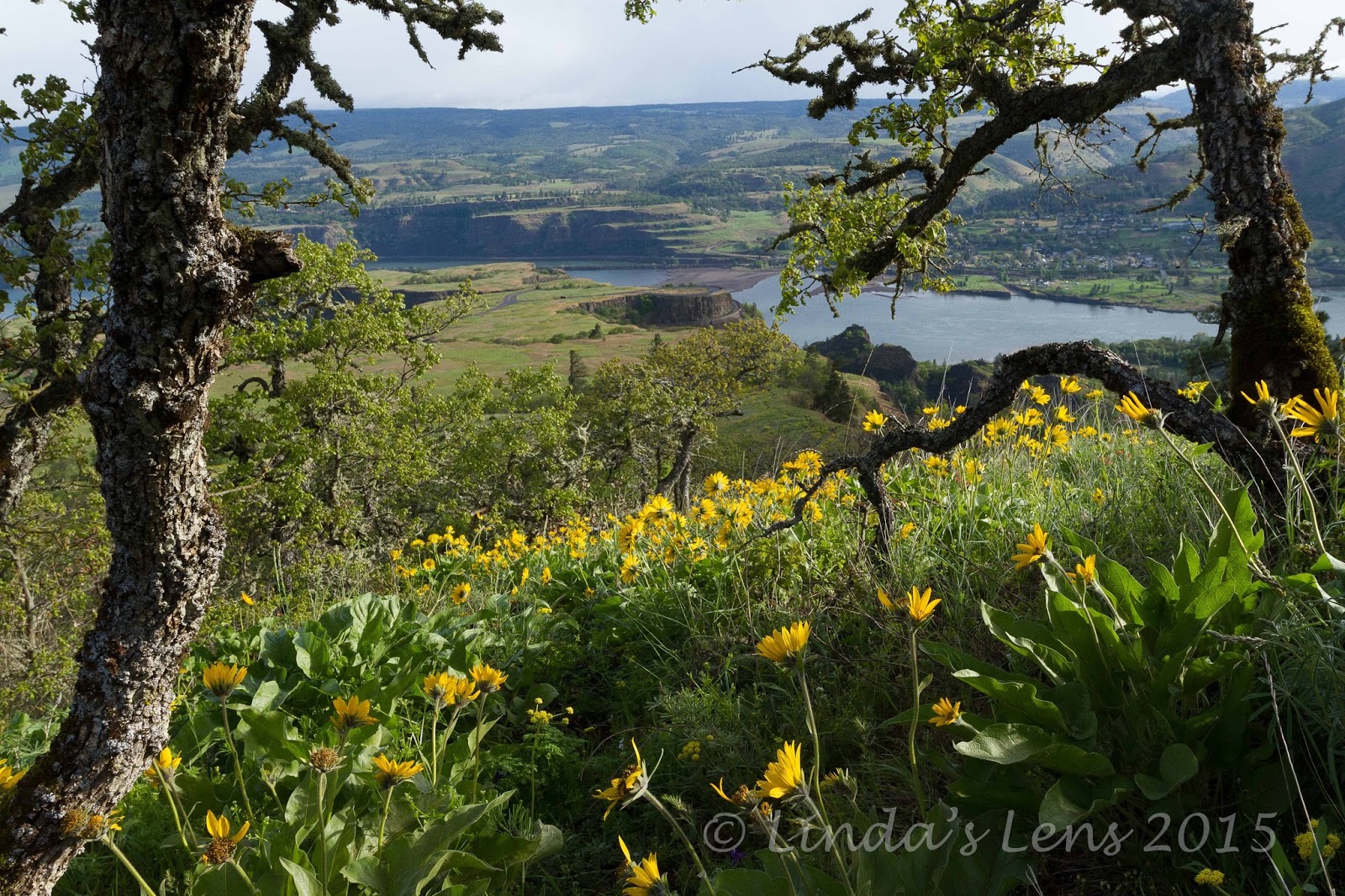
Sunrise on the balsamroot

I've become hooked on early morning light.  Blame my recent photography class, but I've discovered rising at o-dark-thirty has it's benefits.  For one, colors look so much richer in the wee hours.  For two, there's a whole lot less people.


As I ascend, the Gorge views open up

My destination on this late April morn - Tom McCall Point in the eastern Columbia River Gorge.  Located east of Mosier, it rises above Rowena Crest's high plateau.  The entire area is managed by the Nature Conservancy, who has preserved it's unique landforms and flora for all to enjoy.


Balsamroot everywhere!

A good hour and a half drive from my home, I didn't quite get out the door in enough time to catch sunrise.  Sun's rays peeped over the cloudy horizon as I was rounding the final turn.  The day's first light illuminated a lovely rainbow.  I raced to park and get a photo, but it quickly faded upon my arrival.  Drat!


Looking down on the Columbia River

Although I'd been foiled by the sunrise and rainbow, I hadn't missed the spring bloom.  Even better than my visit two week's prior, balsamroot had exploded across the plateau.


Can you see the rainbow?

Shouldering my backpack, I headed to the trailhead, at the beginning of a flowery meadow.  Tom McCall's summit rose high above.  The mountaintop looked so far away.  Although only a 1100 foot elevation gain in 1.7 miles, the climb appeared daunting on this cloudy spring morn.


Paintbrush on the hillside

The first meadow was chock-full of wildflowers.  Balsamroot was so thick, it looked like a golden sea.  Patches of deep purple lupine mixed in with yellow and greens into a lovely kaleidoscope of color.  It took my camera and I a long time to traverse it's length.


Columbia River view

Beyond this meadow the climbing really began.  As I trudged upward, the high plateau became smaller, and the Columbia River spread out below.  Around every turn was another tremendous view, worthy of a photo stop.  At this rate, I'd never reach the top!


Oak trees line the path

I passed through a lovely grove of gnarled oak trees.  Beyond the trees was a huge patch of wildflowers, with the deepest purple lupine I'd seen yet.


Flower garden!

Of course springtime does bring a few hazards to the eastern Gorge.  Shiny new poison oak leaves lined portions of the trail, threatening to intrude upon the path itself.  It's one of the reasons I always hike in long pants.  That, and this area also has a reputation for ticks.  Sticking to the trail lessens one's chances of an encounter with either.


From on top of McCall Point

Frequent photo stops delayed my arrival on top, and it took a good two hours before I was finally taking in Tom McCall Point's commanding view.  Devoid of trees, one could see for miles in all directions.


Looking towards the Eastern Gorge

The mighty Columbia snaked through the gorge like a tiny blue ribbon.  Steep wrinkly hills on the Washington side alternated between shade and sunshine.  The ultra-green Rowena Plateau spread out directly below.  But looking to the west, I could see a line of dark, heavy clouds heading my way.  Not wanting to be up here in a rainstorm, I decided it was time to head down.


Balsamroot buddies

But before leaving, I fished my new macro lens out of the backpack and swapped lenses on my camera.  I hoped those flowers were ready for their close-ups!


Lupine macro

While the climb up focused mostly on scenic views, my return trip captured the more intricate details.


Raindrop-studded lupine leaves

I didn't lack for photo subjects.  Besides the zillions of balsamroot blooms, there were also many lovely stalks of lupine.  And glittering dew drops on the lupine leaves looked like tiny diamonds.


Chocolate tiger lily

Then I happened to glance down at just the right moment, and there it was!  A small patch of rare chocolate tiger lilies.  My favorite wildflower!  So stunning, the petals were still wearing droplets of the morning's dew.  Slightly off trail, I had to kneel in the tall grass to get my shot.  But ticks and poison oak be damned - I had a flower to photograph!  This was hands-down my favorite image of the day.


Bright bug in the lupine

In another location, I spotted this electric blue bug on top of a lupine stalk.  And the little guy struck a pose just for me!


Indian paintbrush


I passed several patches of brilliant orange Indian Paintbrush, which also got some proper attention from my camera.


Curvy road from on high

Oh, the trip down was magical!  Between the flowers, the high overcast sky (perfect light for photographs!) and views such as this one, of the curvy road around Rowena Crest, I had as much fun hiking down as the initial climb up (maybe more!)


Friendly butterfly

And, as I emerged into the flowery meadow where I'd begun this morning, a lovely orange butterfly landed in a flower and held still long enough for a portrait.  What a great way to end this wonderful hike!

Since I'd gotten an early start, it wasn't even noon when I reached my car.  There was time for one more short trek.  And I knew just the place - turning westward, I headed towards Eagle Creek and it's wonderful mossy, waterfall-filled canyon.  To be continued........


Back to the flower-packed meadow

Checking my stats, I realized this is my blog's 500th post.  When I took up blogging seven years ago, I had no idea how this little hobby of mine would evolve.  I certainly never imagined I'd be here blogging in the year 2015.  Thanks all you readers, I'm still plugging away, sharing my humble adventures.

I'd also like to thank Mersad Donko, at Mersad Donko Photography for choosing my blog as one of the "10 Photography Blogs You Need to Follow."  I'm honored to be included in this list.  If you haven't already, please give Mersad's website a visit.  His photography is fantastic!


Sharing with:  Our World Tuesday and Wednesday Around the World.