Wednesday, May 21, 2014

Mosier Plateau

Rowena Crest and Tom McCall Point, east of Mosier, Oregon are my "go-to" places for spring wildflowers.  And I've explored the Columbia River Historic Highway just west of here.  But I've never spent any time in the town of Mosier itself.  A trip report on the Portland Hikers website changed all that.  It described a lovely little ramble starting in the middle of town, that led visitors past a pioneer cemetery and waterfall, before climbing to the top of a panoramic plateau with incredible Gorge views.


Bachelor button!

A new hiking path amongst this well-known spring wildflower paradise?  Of course I had to investigate!  So after spending all morning on the Washington side of the Gorge checking out the Dalles Mountain Ranch and Horsethief Lake State Park, I crossed the river and headed to Mosier.
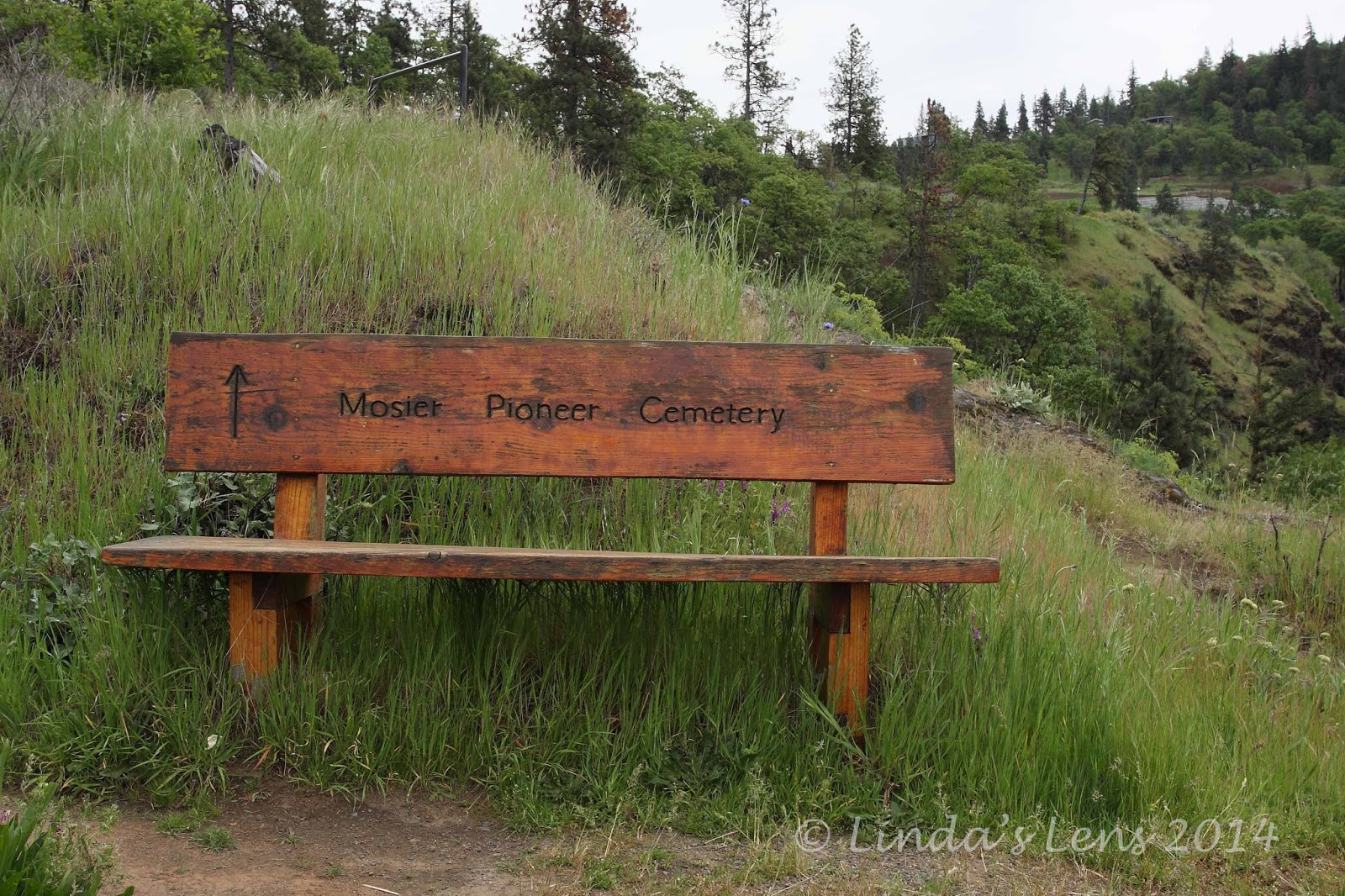

This bench doubles as a sign

As with a lot of the information I find on the internet, directions to the trailhead were a little sketchy.  Supposedly, this hike started next to "the bridge" in the middle of town.  But after crossing over a small auto bridge, I spied this bench on an adjacent hillside.  No worries! 
 

The pioneer cemetery was in a lovely setting

Wildflowers lined this trail from the very start.  Brilliant blue bachelor buttons grew in abundance across the hillside.  A short climb from the roadway brought me to a tiny cemetery, overgrown with weeds and purple flowers.


One of the original Mosiers

A dozen headstones were scattered across the area.  Reading the inscriptions, I saw that many of them bore the Mosier name and were from the late 1800s.  It appeared some of the original town founders were buried here.


Live flowers decorate this grave

The lupine bloomed profusely.  Through a gap in the trees, one could see the Columbia River below.  It was a beautiful final resting place.


Another Mosier gravesite

Beyond the cemetery, my path leveled out, and began to follow the rim of a steep canyon.  This cute sign announced the beginning of the town's "pocket park."


Cute sign

Walking along the rim, I glimpsed a few houses on the opposite side, perched precariously on the very edge.  A beautiful place for a home, but I'd be afraid of it sliding down the steep canyon walls.


Mosier Creek Falls

I began to hear roaring water.  The sound grew louder, until I came upon a mighty waterfall, Mosier Creek Falls, churning through a gap in the rocks.  This cascade, measuring in at 100 feet in height, rivaled anything you'd see further west in the Gorge.


A lizard friend

A small railed overlook gave visitors a vantage point.  While setting up my camera here, I happened to glance down, and caught this little lizard looking up at me.  He was posing so nice, I had to include him in the photo shoot.


Mosier Creek

Downstream from Mosier Creek falls is equally scenic.  I'm told this area is a popular swimming hole during hot summer months.


The trail winds through a grassy slope

From the waterfall, my path again started to climb.  I wound through a steep, grassy slope, chock-full of many wildflower varieties.


Corydalis

The pink corydalis looked like little frilly tubes.  I also passed by large fields covered with more bachelor buttons.


The town of Mosier far below

My path began to steepen.  I was really gaining elevation.  Through a few gaps in the trees, I glimpsed the canyon's green outline, and the town proper.


View from Mosier Plateau

And then, I was on top of the plateau.  The Columbia River spread out before me, wide and blue.  There blooming before my eyes, were incredible numbers of bright yellow balsamaroot  flowers.  The purple lupine also joined in the party.


Tiptoe through the flowers

I wandered around the plateau's grassy top, just taking in all its beauty.


The balsamroot was thick

A small sign by a railed viewpoint explained that this windswept tableland was owned by the Friends of the Columbia Gorge.  A nonprofit group dedicated to preserving this wonderful unique part of Oregon, they had purchased the land and constructed a trail so all could enjoy its wonderful vistas.


Cheery lupine

Views up and down the Gorge were outstanding.  This alone was worth climbing that steep slope.  But the prolific floral display -  icing on the cake!


Flowers and views

After soaking in the scenery and taking tons of photos, my sore broken rib let me know it was done for the day.  So I retraced my steps down the trail, past the waterfall, stopping briefly at the cemetery for a few more shots.


More lovely bachelor buttons

As I approached trail's end and my car, I again passed through the bachelor button field.  These tiny blue flowers waved in the wind, as if to bid me goodbye.  A lovely final image from a wonderful day of exploration.


Sharing with: Weekly Top Shot.

Saturday, May 17, 2014

Petroglyphs

I stumbled upon the petroglyphs at Washington's Horsethief Lake State Park purely by accident.  After spending most of the morning at nearby Dalles Mountain Ranch, I only stopped by this park to use the bathroom.  But upon spotting a sign for a "petroglyph area" I decided at the last minute to check it out.


Ancient writings

Turned out to be a great decision.


Rock etchings

I came upon a paved walkway lined with railings.  Beyond the railings, placed next to a basalt wall, were numerous rocks with ancient symbols etched in them.


Viewing area

These rocks were petroglyphs, images carved into a rock.  The rock's weathered surface had been scraped away, showing a lighter layer below.  This unweathered inner layer then made the design stand out from the outer surface.  Indian tribes who lived in this area long ago created these images, etching them into the basalt cliffs that lined the Columbia River.


Warning!

After heeding the ominous rattlesnake warning sign, I cautiously made my way to the first group of petroglyphs.  They were amazing!  I clicked off a couple of shots (and gave thanks I'd brought a zoom lens) before moving on to the next set.


A gecko?

Some of the designs were intricate.  There were pictures of deer, bighorn sheep, what appeared to be a bird, and a few half animal/half human type creatures.  All very detailed.  These ancient people were good artists.


This one was my favorite

There were a couple dozen etched rocks in the formal display area.  Upon reading one of the interpretive signs, I learned that the nearby basalt cliffs held many more of these historic artworks.  However, the cliffs are closed to the public (probably to prevent theft and vandalism) and can only be accessed by guided tours. 


This one is called "Water Spirit"

Later internet research uncovered some interesting facts about these petroglyphs.  In very early times, vast numbers of Native peoples would come to this area during salmon migrations to fish, trade, and socialize.  The tribal groups believed that a connection with their environment and the spirit world existed within the nearby basalt rock walls. 


Looks like a deer

Archeologists have found more than 160 rock art sites in this lower portion of the Columbia River.  Some of the Northwest's oldest Native American artwork can be found in this park.


More fascinating drawings

The Lewis and Clark expedition camped at a Native village in this area, and described its wooden houses in one of their journals. 


Not sure what this one is supposed to be

The petroglyph rocks on display at this park were removed from the walls of the Gorge prior to the area being flooded by construction of the Dalles Dam.  They were stored within the dam for over 30 years.  This wonderful interpretive area came into being due to requests from the local Native American tribes.  Their perseverance brought the artwork out of hiding for all to enjoy.


This one is called "Speedis Owl"

I sure enjoyed viewing these interesting works of early Native American art.


You can barely make out the sheep etched in this rock

A wonderful discovery at an out-of-the-way, nondescript state park.  Good thing I had to use the restroom!


Steep cliffs along the river

But it was time to move on to the day's final destination.  I'd gathered some beta on a spectacular little-used trail that meandered above the town of Mosier.  Time to cross the river into Oregon and check it out!  Come back for my next post and see what I found.


Sharing with:  Weekly Top Shot. and Our World Tuesday.

Wednesday, May 14, 2014

Hunt for the Auto

 The car.....the car.....where, oh where was that car?


Gorgeous flower fields

I'd rambled around the upper bluffs of the Dalles Mountain Ranch, and explored the old homestead with it's preserved barns and ancient farming equipment.  (If you missed that post read all about it here.)  But I'd still yet to find the ancient auto.


Peek a boo barn

Many online descriptions of the Dalles Mountain Ranch mentioned a decaying automobile long ago abandoned in a field of flowers.  It's rusting hulk in such a beautiful setting made for some scenic photos - a favorite subject of many area photographers.  After viewing several people's images online, I knew I had to find that car.


Yellow slopes

However, easier said than done.  The people who posted online reports didn't offer many concrete clues as to the car's location.  And the Dalles Mountain ranch covers a huge area.  About all I came up with was that it was located "near the buildings," and from glimpsing photographs, I determined it was close to a fence.  But there were a lot of fences out here.  Would I be searching for a needle in the haystack?


Balsamroot bloom

But I had to give it a shot, and crossed the main road opposite the old homestead and plunged into more flower-filled fields.  The amount of bloom was staggering.  Bright balsamroot flowers colored the rolling hills yellow, stretching for miles in all directions.  It was as if someone had taken a huge paintbrush to the fields.


Another scenic fence

The fields were lined with an incredible amount of fencing.  I know this area used to be a cattle ranch, and I'm sure the fences were left over from those days.  However, I didn't mind.  The old, wooden posts made fantastic subjects.


One more scenic fence

I followed well-worn user paths through the flower fields.  Although no car came into sight, I thoroughly enjoyed myself taking photos of the flowers and fences.  Along with the balsamroot, bright purple lupine added to the palette.  The hills, dressed in their neon spring green, ambled down as far as the eye could see, all the way to the Columbia River.


Lots of purple lupine here

After spending quite a bit of time in my photo endeavors, I looked across a draw to another large field.  I spotted a small group of people walking along a fenceline.  Watching the group for several minutes, they seemed to linger in one particular spot.  Could that be the place?


Found it!

I had to check it out.  Returning to my car, I drove closer to this field.  After squeezing through a gate, I trekked up a small hill.  The concentration of balsamroot and lupine was quite thick, overgrowing a very faint path through the flowers.  And then, topping the ridge, I looked down into another fenced field......and there was the car!


This car has seen better days

It was as scenic as the internet pictures depicted.  The car's orange, rusty hulk lay partially buried in a huge field of balsamroot.  The car, which I think was an old Studebaker, looked as though it had been there for some time.  All it's windows were broken out, the interior gutted, and the steel body slowly deteriorating.


Broken window

But, oh the photo ops!


Vivid purple lupine flowers

I spent quite awhile photographing the prize I'd sleuthed to find.  Not only this abandoned auto, but the flowers were especially thick and vibrant here.  Truly a magical place!
 

Yellow was everywhere

My trip to the Dalles Mountain Ranch was a resounding success.  Not only did I hit the bloom at prime time, I found a wealth of history in an old homestead, and successfully located the rusty car, a favorite subject of photographers throughout the PNW.


Lovely final resting place

There's still a few more photos to share from the day's trip.  After leaving the Dalles Mountain Ranch, I checked out some petroglyphs at nearby Horsethief Butte State Park, and then crossed to the Oregon side of the Gorge to take in more amazing sights on the Mosier Plateau.  Stay tuned!


Due to the large amount of fence shots in this post, I just have to share with Good Fences.

Sunday, May 11, 2014

The Dalles Mountain Ranch

My travels in the Columbia River Gorge have taken me to many places.  I've hiked nearly all the trails on both sides of the Gorge.  Visited many a historic site, and even camped in a couple of the campgrounds.  But I'd yet to visit the Dalles Mountain Ranch.

That is, until now.


Early morning Gorge scene

Recently I'd read many great reports about this scenic, rolling grassland on the Gorge's eastern fringe.  Word was that spring wildflowers bloomed in great abundance on its slopes.  A local hiking website posted some great photographs of the area.  That was all the encouragement I needed.


The flowers are out!

The ranch was a bit of a drive from Portland.  Located on the Washington side of the Gorge, across from The Dalles, it's a good two-hour trip.  Wanting to catch the morning light, I left my home at o-dark-thirty.  But my early start was rewarded.  Pulling onto the ranch's access road, I was greeted with lovely, warm sunshine.


Yellow balsamroot carpets the hillside

The road to the ranch itself is not signed, so it took a few wrong turns before reaching my destination.  But the countryside was so open and lovely, I really didn't mind.


Balsamroot blooms

My first stop was the end of a rough, gravel road midway up the riverside bluffs.  From the parking area, wide grassland spread out before me.   Far below was the Columbia River.  To the west, a white topped Mt. Hood anchored the horizon.


Mt. Hood peeks over the horizon


Huge patches of yellow stood out amongst the green spring grass.  These were the balsamroot blossoms.  With cheerful yellow petals that resemble a sunflower, these flora are a common springtime sight in the eastern Gorge.


Spring has turned these hills green (and yellow)

The balsamroot bloom in such large numbers, they carpet the adjacent hillsides.  These huge spring floral displays are what the Dalles Mountain Ranch is famous for.


A blue sky day

Although the western end of the Columbia River Gorge is thickly forested with Douglas Fir, ferns, and moss, the Gorge's eastern end is barren and dry.  Located in the rainshadow of the Cascade Mountains, it's always amazing to me the stark differences in vegetation one encounters during the two-hour trip from Portland east.


Cool old fences were everywhere

Not only balsamroot, but bright purple stalks of lupine poked up and mixed with the yellow riot of flowers.  Although the balsamroot were about a week past their prime, the lupine were just reaching peak bloom.


The lupine was also blooming

The Dalles Mountain Ranch is located on the site of an 1869 homestead, the first in this county.  Another homestead, owned by the Crawford family, was settled in 1878.  The Crawford's ranched and farmed in the area, even operating a dairy for a short time.  Over the next century, the Crawford homestead and the adjacent hills continued as a working cattle ranch, until the Bleakney family deeded the property to the state of Washington in 1993.


View of the ranch from above

Part of this 9,000 acre property was set aside for protection of native plants.  Cattle-free for nearly 20 years, this land has once again reverted to it's natural condition.  It now boasts numerous native plants and shrubs, as well as populations of mule deer and wild turkeys.


Interesting wagon from a bygone era

Not only huge vistas of grassland flower gardens, the Dalles Mountain Ranch has also preserved many of the old ranch buildings.  Heading back down the gravel road, my next stop was a visit to old homestead.


Old iron wheels

A very interesting place indeed!  Not only did I find the old barns and farmhouse, in the nearby field was an extensive collection of rusty vintage farm equipment.


Flowers and old farming equipment

I had a blast walking amongst the wagons, threshers, plows, and other unidentifiable implements from a bygone era.  Bright wildflowers bloomed in large numbers between the displays, making great backdrops.


Small cemetery

Amongst the farm equipment, I discovered a tiny pioneer cemetery.  One of the two headstones was inscribed with a date of 1890.  So very interesting to discover a small bit of local history.  One can only imagine how difficult life must have been in this remote, harsh location.


Gravestone inscription

This area was finally declared an official state park in 2003, when it combined with nearby Horsethief Butte State Park.  Recently, the entire area has been renamed the Columbia Hills State Park, whose boundaries now stretch from Columbia River's banks to the top of Stacker Butte (which rises to an elevation of 3,200 feet).


Weathered ranch buildings

Because it's such a new park, there are no visitor facilities.  People are allowed the walk amongst the ranch buildings, but cannot go inside.  However I did observe construction nearby of what appeared to be a formal parking lot and restroom building.  So changes are in the works.  Which is a good thing, for this area is fast becoming a popular early spring destination.


Fence shadows

I wandered around the farm buildings, shooting whatever caught my eye.  Although I normally like to shoot landscapes, the weathered buildings and fences made great photo subjects.


Green hills towards the river

Across the road, beyond a shabby corral, I saw another rolling hillside carpeted with more yellow blossoms.  From reading a local hiking website's trip reports, I knew there was an old rusted car, left to decay, somewhere in those flower fields.


Fence posts make good photo subjects

So.....I set out across the grassy plains in search of this ancient auto.  Would I be successful in my quest?  Well, you'll have to come back and read my next post to find out!

(I promise there will be more fantastic wildflower shots.)


Sharing with:  Our World Tuesday.