
Saturday, September 7, 2024

Summer at Mt. Hood Meadows

As many of you know, I plan my spring and summer hikes around locations where wildflowers are blooming.  This summer I hit many of the well-known wildflower trails near home.  Surprisingly one of the best color shows I encountered was on the slopes of my local ski resort. 


Hike No. 1 - Wildflowers brighten the ski slopes

Every winter, I spend many happy days days zipping down the ski runs at Mt. Hood Meadows.  But in the past, when summer rolled around, it wasn't a place I visited much.  Although the Timberline Trail cut through the middle of this resort, I'd never explored much beyond it.  Then a few years ago, Mt. Hood Meadows management decided to build a network of hiking trails within its permit area and open the resort for summer recreation.


No. 1 - Recently bloomed asters

Now every summer I try to plan some hikes through the "familiar-to-me" ski trails of Mt. Hood Meadows.  Most people probably think ski runs are dull, barren wastelands during summer months.  While that may be true of some ski resorts, it certainly isn't at Meadows.


No. 1 - Wonderful color spot

There's a reason this resort is named "Mt. Hood Meadows."  During summer months its ski runs transform into lovely wildflower meadows.  The wildflower show here normally starts about mid-July and lasts throughout the summer until early September.  This year I took three hikes at Mt. Hood Meadows, and each visit was just as stunning.  I really want to share some of the wonderful color I found.  So I've compiled the best photos from each hike and put them together in one mega-blog post just for you readers.
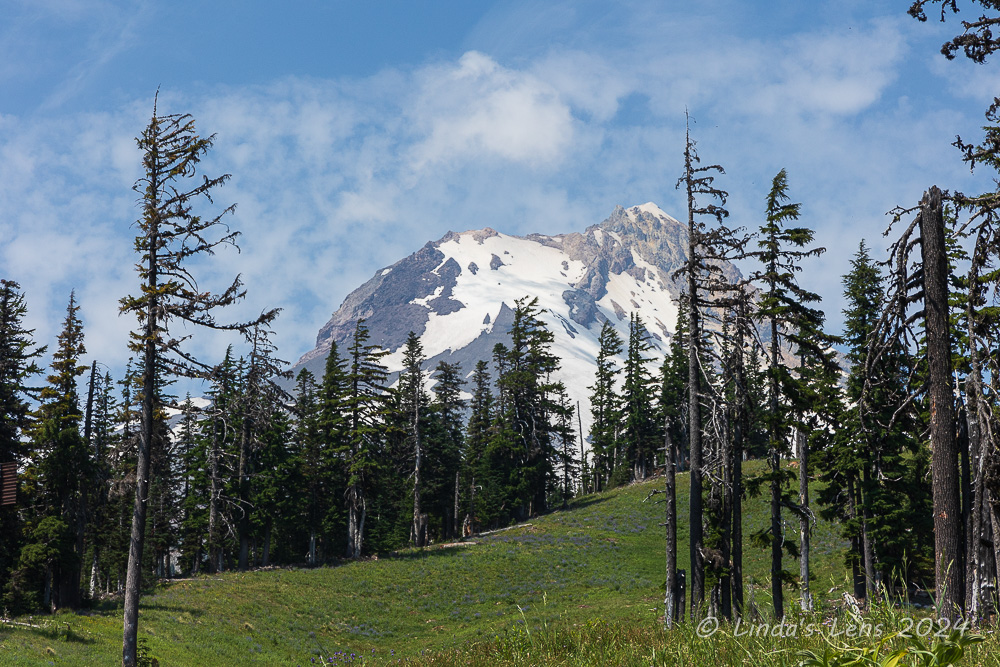

No. 1 - Mt Hood was lookin' good too

My first Meadows hike was on July 26th.  Good friends Debbie and Barry came along and we did a loop that encompassed trails on both the east and west sides, linked together by a jaunt on the Timberline Trail.


No. 1 - Flowers just starting to bloom under the Stadium lift

Although we could tell there were lots of wildflowers yet to bloom, the orange Indian paintbrush, lupine, and Western Pasque flower seed heads were prolific and lovely.  My friends and I had a wonderful time walking through several technicolor meadows.  Goldenrod, asters, fireweed, and a few other species were nearly ready to pop open.  I made a mental note to plan a return trip very soon.


No. 1 - Fireweed just getting started

As it turned out, I was back a week later with my buddy Kim.  Accompanying me for many of my winter ski trips she was eager to see what our local resort looked like sans snow.


Hike No. 2 - One week later and lots of wildflowers in bloom!


And boy what a difference a week can make!  For hike number two, there were tons of wildflowers in full, colorful bloom.  I think we caught things at peak.


No. 2 - The fireweed was thick!

A field of fireweed that wasn't quite ready the week prior was now in a full, dazzling pink frenzy.


No. 2 - Pink blast of color

Not only the fireweed, there were many more Western pasque flower seed heads dotting the ski slopes.  I love these mop-headed flowers.  They have many nicknames, but my favorite is "hippy on a stick."


No. 2 - Western Pasque flower seed head


Walking under the main chairlift, Kim and I were treated to fields upon fields of orange Indian paintbrush and purple lupine all in maximum bloom stage.


No. 2 - Mariposa lilies

Another great thing about the day we were there, a thin layer of clouds kept things a bit cooler and provided nice even light, perfect for photography.  


No. 2 - Orange Indian paintbrush was prolific!


Enjoy the next few photos of the flowerful meadows at Mt. Hood Meadows.


No. 2 - Paintbrush and lupine


No. 2 - Lotsa lupine


No.2 - A butterfly enjoying the bloom


I've been trying to get Kim interested in hiking with me, and after that day I think I made a convert!  


No. 2 - Purple streaks in this meadow

Not only did Meadows open their restrooms and cafeteria, serving food and drink to hungry hikers, they also ran one of their ski lifts, taking hikers straight to the higher elevation trails.  For a price, people could get up to the alpine areas without a lot of effort.  


Riding the ski lift back down


For season pass holders, the lift ride was free.  Since Kim and I have had seasons passes for like forever, we took advantage of this perk and rode the lift back down when we were finished with our hike.


Look ma, no skis!

We both agreed it was weird to be riding a ski lift downhill without skis strapped to our feet!  


Hike No. 3 - End of August and wildflowers were still blooming up high


My final visit of the summer season was about two weeks ago, on August 26th.  Debbie and Barry wanted to check out the bloom higher up on the mountain, and I was curious to try some of the upper trails that I'd never before hiked.  So back I went to Mt. Hood Meadows for a third time.


No. 3 - Flower-filled gully


Although the lower meadow flowers were just about finished, my friends and I found lots of wildflowers still blooming above the Timberline Trail.


Mt Hood Express lift without snow

After climbing past trails we'd already hiked, Debbie, Barry and I started climbing up a trail called "Wizards Way" which took us up an amazing flower-filled gully.


Barren, rocky slope under the lift

Then we passed by the top of the Mt. Hood Express lift.  I'd never before seen this lift not surrounded by snow.  At a much higher elevation, was a bit bleak up here.  Lots of rocky slopes and not many wildflowers.


No. 3 - Goldenrod still blooming well


My friends and I ended up climbing a bit higher than Mt. Hood Express.  However, the trail wound through an extremely rocky area and it was hard to find our path.  A few areas were so steep we had to use our hands to climb.  There was no shade, and with the sun beating down upon our heads everyone was tiring fast.  We finally turned back near the 7000 foot elevation mark.

No matter, the flowers were much better below 6500 feet anyway.  Goldenrod, fireweed, asters, and pearly everlasting were the stars on this day.


No. 3 - Fireweed is hanging on


Many ski areas open their slopes to mountain biking during the summer months.  I'm so grateful that Mt. Hood Meadows has instead catered their summer activities towards hikers.  I couldn't bear to see these beautiful slopes torn up by bikers.  Stopping back at the lodge after our hike, I thanked one of the workers for creating such a wonderful place for hiking.  Each time I've visited, I made sure to buy some food and drink from their snack bar - I want to support the ski area and ensure these summer activities continue!


No. 3 - Lots of color under the lift now!

It's been a great summer and I have many more wildflower hike photos to share.  Hopefully I'll have time to post a few more of them before I get busy with fall color hikes.


Saturday, August 31, 2024

Ape Canyon

Are there really apes in Ape Canyon?  (Inquiring minds want to know!)

Over the many times I've hiked here, no apes have ever been spotted.  But I do know if you want to get some great views of Mt. St. Helens, travel through a spectacular old-growth forest spared from the eruption, and in July see a great wildflower show, then the Ape Canyon trail is for you.


Young admiring the big trees


In mid-July a desolate pumice plain on the SE side of Mt. St. Helens called the "Plains of Abraham" erupts into a purple frenzy thanks to huge amounts of lupine and penstemon wildflowers.  The best way to reach this flowerful place is via the Ape Canyon trail.  One needs to climb 5 miles up Ape Canyon to rendezvous with the round-the-mountain Loowit Trail.  Then there's another mile or so on the Loowit to reach this stark, but beautiful area.

Hoping to catch the wildflower show on the Plains of Abraham, I invited my hiking buddy Young to join me for a trek up Ape Canyon.  Although it was near the end of July, I hoped that the flowers were still going strong.  One way to find out!


First mountain viewpoint

Driving to the trailhead proved to be a bit of an adventure, due to a recent road wash-out.  But luckily Young drives a sturdy truck which traversed the damaged road no problem.  We found cloudy skies and cool temperatures at the base of Ape Canyon.  Although there were zero mountain views, after weeks of enduring unseasonably hot weather today's chilly temps were just fine with us.


Trailside wildflowers

To start out, the Ape Canyon trail followed a cliff overlooking a huge lahar.  This barren floodplain was created from a flow of mud and rock down the Muddy River, unleashed during the 1980 eruption.  However the adjacent forest, which we were now hiking through, was somehow spared from the eruption's damage.  The first mile and half wound through second-growth forest, logged many years ago.  Beyond this point, we entered an area of untouched old-growth woods.  Young and I gaped at the huge fir and cedar trees lining our path.  The trail climbed steadily uphill, gaining 2500 feet over the course of 5 miles.


Approaching the Loowit trail junction

The only drawback to hiking this trail is that it's shared with mountain bikers.  Although all the bikers I've encountered here have always been polite, the threat of encountering one speeding downhill keeps me on edge.  Today just a mile up the trail my fears were realized when we had a near run-in with a downhill bike rider.   A young man unexpectedly whipped around a corner and nearly hit us.  Young and I scrambled off the trail in record time.  (I may have also screamed.)  The biker slammed on his brakes and immediately apologized.  He said since he hadn't seen any hikers thus far that day, he wasn't being very diligent in looking out for them.  The guy was so nice about the incident, we told him "no harm, no foul" before parting ways.


Desolate, but beautiful


As the morning wore on, the clouds surrounding MSH started to lift.  When Young and I reached the first viewpoint, about 3.5 miles up, we could now see the mountain's base.  That was encouraging!


Nice flower patch near a spring

About 4 miles along the Ape Canyon trail, the forest receded and we entered the desolate blast zone.  Climbing towards the Loowit Trail intersection, the green Ape Canyon narrowed down into a slot chasm.  A few wildflowers bloomed along the trail, but not in huge numbers.


Made it to the Windy - Loowit junction


After a long climb, the sign marking the Loowit Trail junction was a welcome sight.  From here, Young and I then headed eastward, now following the Loowit Trail, hoping we'd spot some wildflowers soon.


Reading the trail signs

About 3/4 mile from the Loowit - Ape Canyon junction, my friend and I passed a wet area where a small spring bubbled out of the earth.  On the side of a small rise was a nice patch of lupine and orange Indian paintbrush.  The best display of wildflowers thus far, I put my camera to work. 


MSH was starting to emerge


Just beyond the colorful wildflower patch, Young and I stopped at an overlook for lunch.  On a clear day, one can see Mt. Hood and Adams from atop this rocky cliff.  But today clouds obscured most of the views.  No matter, we were hungry and were happy for the nice rest area.  However, the wind began to blow and chilled us so much that Young and I donned our jackets and hoods to stay warm.  After hiking in heat most of the summer thus far, it felt strange to be cold again.


Purple wildflowers lined the trail


Bellies now satisfied, we continued our journey eastward in search of the wildflower bloom.  However, traveling from the spring area we came upon the Plains of Abraham proper and there were hardly any flowers, just a desolate stretch of gray pumice.  It appeared we were too late.  I recognized numerous dried-up penstemon blooms spread out along the landscape.  The unseasonably early hot weather appeared to have already baked most of the wildflowers.


We spotted a mama grouse

Although disappointed to miss the peak bloom, Young and I continued on towards the junction of the Loowit and Abraham Trails.  Happily, there was a bit of lupine still flowering, so I wasn't totally skunked in the wildflower department.  And although the wind kept things chilly, the clouds were lifting and we could now see quite a bit of Mt. St. Helens.


Back through the flower garden

Young and I made it to the Loowit-Abraham junction.  We took a few pictures of the stark landscape, and marveled at the far-reaching views.  But because it was still quite cold, we didn't linger long.  After about five minutes of gawking my friend and I turned around to retrace our steps back to Ape Canyon.


Best wildflower patch of the hike

Sometimes one sees mountain goats on the hills adjacent to the Loowit Trail.  I'd carried my zoom lens in hopes of getting some photos of these majestic creatures.  But I was skunked here too.  The only wildlife sighting we had for the day was a mama grouse as we were coming back through the spring area.  The grouse had a chick hiding in a nearby bush, and she kept distracting us by walking down the trail, hoping to lead us away from her young one.  I never managed to get a photo of the baby, but I did get a few great images of its mother.


Another photo of the flower patch - just because!

About the time Young and I walked back through the large wildflower patch, the mountain had emerged from the morning's clouds and was in full view.  Perfect timing because now I could get flower photos with MSH in the background.  Which is exactly what I did.  Then we headed towards the Loowit Junction, and back down Ape Canyon.


Mt Adams view at the upper start of Ape Canyon

Our day ended with a happy surprise when Young and I ran into old hiking friends John and Dorene as we descended the Ape Canyon trail.  We hiked together for the final two miles and had a great time catching up.  Our total distance came to 13 miles, so I was thankful for the engrossing conversations to distract me from my tired legs and feet.


Ran into some old hiking friends!


In case you were wondering why a canyon in SW Washington has such an unlikely name, here is the reason:  In the summer of 1924, a group of gold prospectors in the area claimed that 7 foot tall ape-like creatures attacked them with boulders.  According to the tale, the miners came across the animals in the forest and a man in their group shot one of the animals three times.  The wounded ape-like creature toppled off a cliff into an inaccessible canyon.  Later, the "ape-men" returned to the prospector's cabin, bombarded it with stones, and left gigantic footprints in the dust.  The story created a local sensation.  Forest Service rangers investigated the men's claims, but found nothing to substantiate their story.  Despite zero evidence, the legend persisted and continued to spread in later years. 

Who knows?  Maybe Sasquatch does live in the woods nearby.  Anyway, I think it's kind of a fun tale. 


Tuesday, August 27, 2024

The Marvelous McNeil Point

One of my top summer trails, I've been hauling myself up to Mt Hood's McNeil Point for many years.  Introduced to me by one of my hiking friends, its stunning wildflower meadows and mountain views kept me coming back each summer.  Multiple notes in an old hiking book show visits dating back to 2000, and nearly every year in the decade and half since then.  However sometime around 2020, thanks to social media, this lovely slice of paradise was "found."  The trail and parking area became so crowded, I decided to forego my annual trek for awhile. 

But last year I started missing McNeil's summer flower show.  It was time to go back!  Trying to avoid the crowds, I hiked there via lower elevation, longer trail.  It was such a slog, this year I decided to suck it up and return to the usual route.


A new sign!

I recruited my friend Catherine to join me for my McNeil Point revisit.  Since she's a teacher and has summers off, we decided upon a late July weekday in hopes of encountering less people.  That, coupled with a fairly early start, ensured us a spot at the small trailhead parking area.


Heading up the ridge

It was a beautiful day!  The sun was out, the temps moderate, and the bugs few and far between.  Catherine and I headed up the first steep climb before junctioning with the Timberline Trail.  We then ascended up this trail, taking in occasional mountain views, wildflowers, and butterflies before coming to a sign pointing the way towards McNeil Point.  I was surprised to see the old, weather-beaten wooden sign that had been here for years replaced with a brand-new version.  To memorialize the occasion, I had Catherine pose beside it for a few pics.


Avalanche lily


After the obligatory sign photos, we began climbing again, this time following the spine of a rocky ridge.  Ducking in and out of scrubby fir forests Catherine and I finally came to a clearing with amazing views of Mt Hood and the adjacent Cascade peaks.


Orange Indian paintbrush highlight this colorful meadow


Past an old trail junction, we contoured along a slope into an alpine wonderland.  Wildflowers bloomed in the meadows here - orange Indian paintbrush, purple penstemon, pale purple asters, white avalanche lilies - and many others.  A few patches of snow lingered nearby.  Our trail even crossed a small snowfield, a bit slippery but doable.


Our goal is in sight


The alpine meadows directly below McNeil Point erupt into a kaleidoscope of colorful wildflowers in July.  Some years are better than others - rainfall, heat, and amount of winter snow all affect the vibrancy and timing of the bloom.  Back in 2013 I witnessed the absolute best wildflower show I've ever seen on this trail.  The pink heather and magenta Indian paintbrush was so prolific - the entire area was absolutely stunning!  (I blogged about it in this post.)  Since that year I've never seen it as good.


We came upon this most excellent meadow


I thought maybe we'd be too late to catch peak bloom.  After several years of either just missing it, or having a less-than-stellar wildflower show, I'd set the bar low.  So imagine my surprise and delight when I came around a bend in the trail to an entire meadow filled with pink heather and magenta Indian paintbrush, all in full, colorful bloom.


Heather and magenta paintbrush as far as the eye could see


As you can imagine, forward progress ground to a screeching halt, as cameras came out and photos were taken.  Many, many, photos!


Absolutely gorgeous!

The wildflower bloom was so amazing it nearly rivaled the fantastic 2013 show.  It certainly was the best I'd seen up here since.


A distant Mt. Adams anchors the skyline

Catherine and I lingered in this wonderful meadow for quite a long time.  (We probably would've gotten going sooner if not for me and my "just one more photo" mentality.)  But finally I decided I had enough images, and we still had a bit of distance and climbing to reach our final destination on McNeil Point.  Onward!  


Lots of wildflowers in this meadow!

The wildflower show wasn't over yet.  We passed by an area of lupine so lush and purple, we nick-named it "lupine alley."  And once upon McNeil Point's plateau, I ran into more flower fields, each as colorful as the next (but not quite as good as that heather/paintbrush meadow below.)


Catherine playing in the snow

Seeing a large snowfield above the trail, Catherine couldn't resist hiking up to it and sliding around.  


Poor McNeil Point stone shelter has seen better days


Despite all our dilly-dallying we did finally reach McNeil Point proper, defined by its old stone shelter.  Built in the 1930's by the Civilian Conservation Corp, the poor structure was looking pretty dilapidated.  A blue tarp covered the roof, anchored by rocks.  With its stability in question, I chose not to go inside.


Flower field and Mt. Hood view


Usually the meadows directly above this stone shelter host a wide variety of wildflowers.  Most noteable are the Western Pasque flower seed-heads, whose wild-haired poofs look like something out of a Dr. Seuss book.  (I've affectionately nick-named them "Hippy on a stick.")  This year's meadow show wasn't nearly as good as in years past.  I really haven't seen a spectacular bloom here since that wonderful day in 2013.  Since 2020, this area has been horribly overused and I suspect the wildflowers have suffered as a result (people - this is why you should stay on the trail!)


We dubbed this spot "lupine alley"


Catherine and I found an unused campsite near the shelter and perched on the rocks for lunch with a view.  Our vantage high above the Sandy River gave us panoramic vistas of the terrain below as well as Mt. Hood's craggy west face with her shrinking glaciers.


So lovely!

Catherine and I returned the way we came, retracing our steps across the McNeil plateau, down through lupine alley, and once again past the wonderful heather and paintbrush meadow.  More photos may have been taken here!


A plethora of paintbrush

From high on the ridge, we spotted the nearby Cascade peaks of Mt. Adams, Mt. Rainier, and Mt. St. Helens.  In addition, smoke from a large wildfire burning in the Columbia River Gorge could be seen.  This one a human-caused wildfire, it's always sad to see more of the forest burning.


Beautiful mountain stream

On the way down, Catherine and I stopped by a lovely mountain stream, fed by snowmelt high on the mountain.  It wound through a patch of green vegetation, highlighted by bright spots of wildflowers, most notably purple lupine.


And there were butterflies!


The warm afternoon temps had brought out the butterflies and as we trekked downhill, I tried to capture a few as they settled onto the wildflowers.  I didn't have the best luck - usually as soon as I pointed my camera on these winged beauties, they nearly always flew away.


Two butterflies caught in a not-so-private moment


However, I was fortunate enough to capture two butterflies busy in a (ahem!) not-so-private moment.  I think they were too busy with each other to notice my camera.


Enjoying the views

It was so good to be back at McNeil Point again for the summer wildflowers.  And although we saw a few hikers, the meadows and shelter area weren't very busy at all.  My overcrowding fears didn't materialize.  Sometime you just have to say "what the heck" and go anyway.  I've found I'm always glad that I did!